Introduction
There has been extensive debate regarding freedom of expression, particularly on social media platforms such as Facebook and others. The key question is at what point the exercise of free expression infringes upon the rights of individuals, organisations, and institutions.
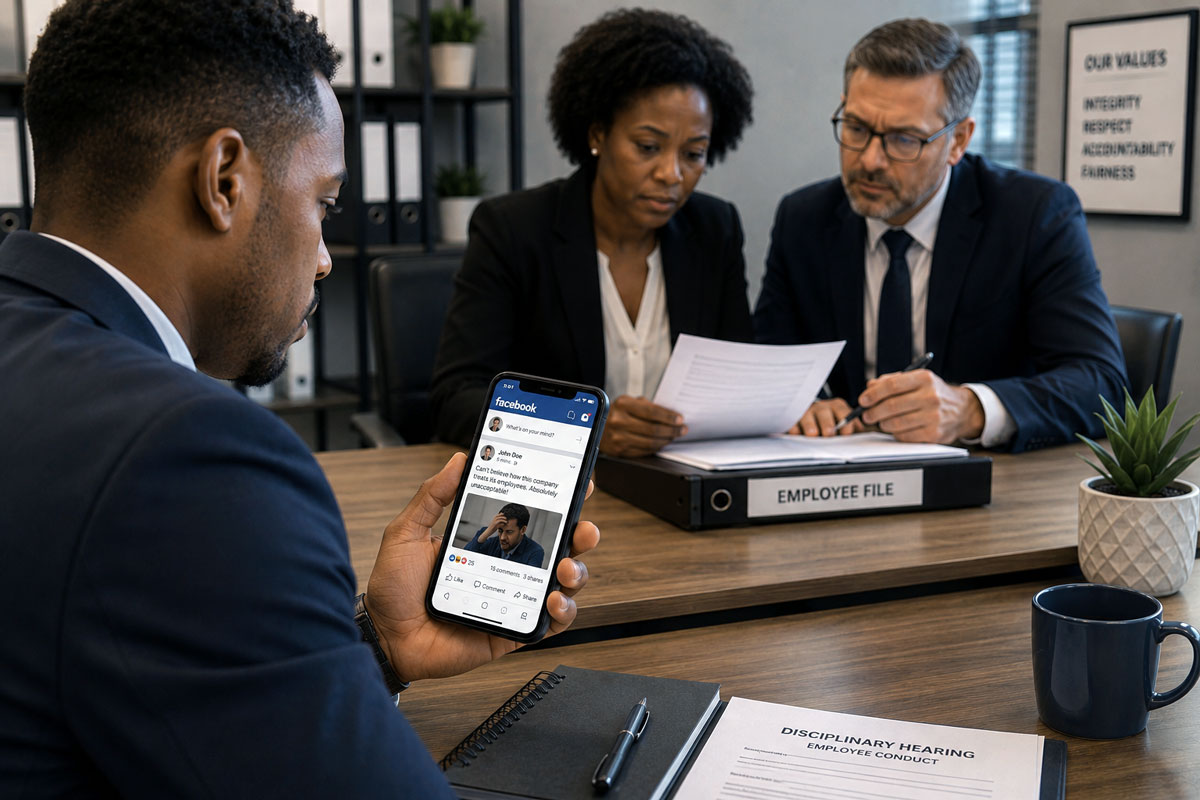
A photograph taken at a Saturday braai. A late-night opinion posted on a personal Facebook account. A TikTok video filmed at home, far from the office. None of these happen at work – yet any one of them can end an employment relationship on Monday morning. South African labour law is still working out when that outcome is fair.
The Nexus Requirement
The starting point is the nexus test: for off-duty conduct to justify discipline, there must be a sufficiently close link between the conduct and the employment relationship. The CCMA and Labour Court have consistently required the employer to show that the post caused – or was reasonably likely to cause – harm to the employer’s reputation, business interests, or the integrity of the workplace. A personal opinion that merely embarrasses the employer, without identifiable damage, generally does not meet that threshold.
The critical variables are whether the employee identified their employer, whether the post was accessible to the public or a closed group, and whether a reasonable person reading it would connect it to the employer’s business.
Freedom of Expression vs. Workplace Obligations
Section 16 of the Constitution protects freedom of expression, and employees do not surrender that right at the gate. However, section 16 does not protect hate speech, and the right is subject to limitation under section 36. Where an employee’s post expresses a political or social view, the employer must clear a high bar before discipline is justified. Courts will ask whether the employer’s response was proportionate, and whether a warning rather than dismissal was appropriate.
Where the post contains racial, gender-based, or homophobic content, the analysis shifts materially. The Employment Equity Act and the Code of Good Practice on Sexual Harassment may impose a positive obligation on the employer to act – not merely a right to do so. Inaction could itself attract liability.
The Procedural Dimension
A recurring procedural problem is dismissal for content that was screenshotted and reported by a colleague, sometimes months after posting. The CCMA has shown sensitivity to the manner in which evidence is obtained and to the time delay between posting and discipline. Employers who act on stale content without explanation risk a finding of procedural unfairness.
The Policy Gap
The single most effective risk management tool remains a clearly drafted social media policy – one that defines prohibited conduct with precision, is communicated to all employees, and is applied consistently. A policy that prohibits employees from identifying their employer entirely, or from making any comment that could embarrass the organisation, is likely to be challenged as an overbroad restraint on protected expression. The better approach is to define the specific harm the employer seeks to prevent and calibrate the prohibition accordingly.
Note:
The law in this area is still developing. CCMA awards are inconsistent, the LAC has not delivered a definitive framework, and the Constitutional Court has not spoken on the employment context specifically. Until the courts provide clearer guidance, employers and employees alike would do well to treat social media not as a private space – but as one where the line between personal and professional remains dangerously thin.